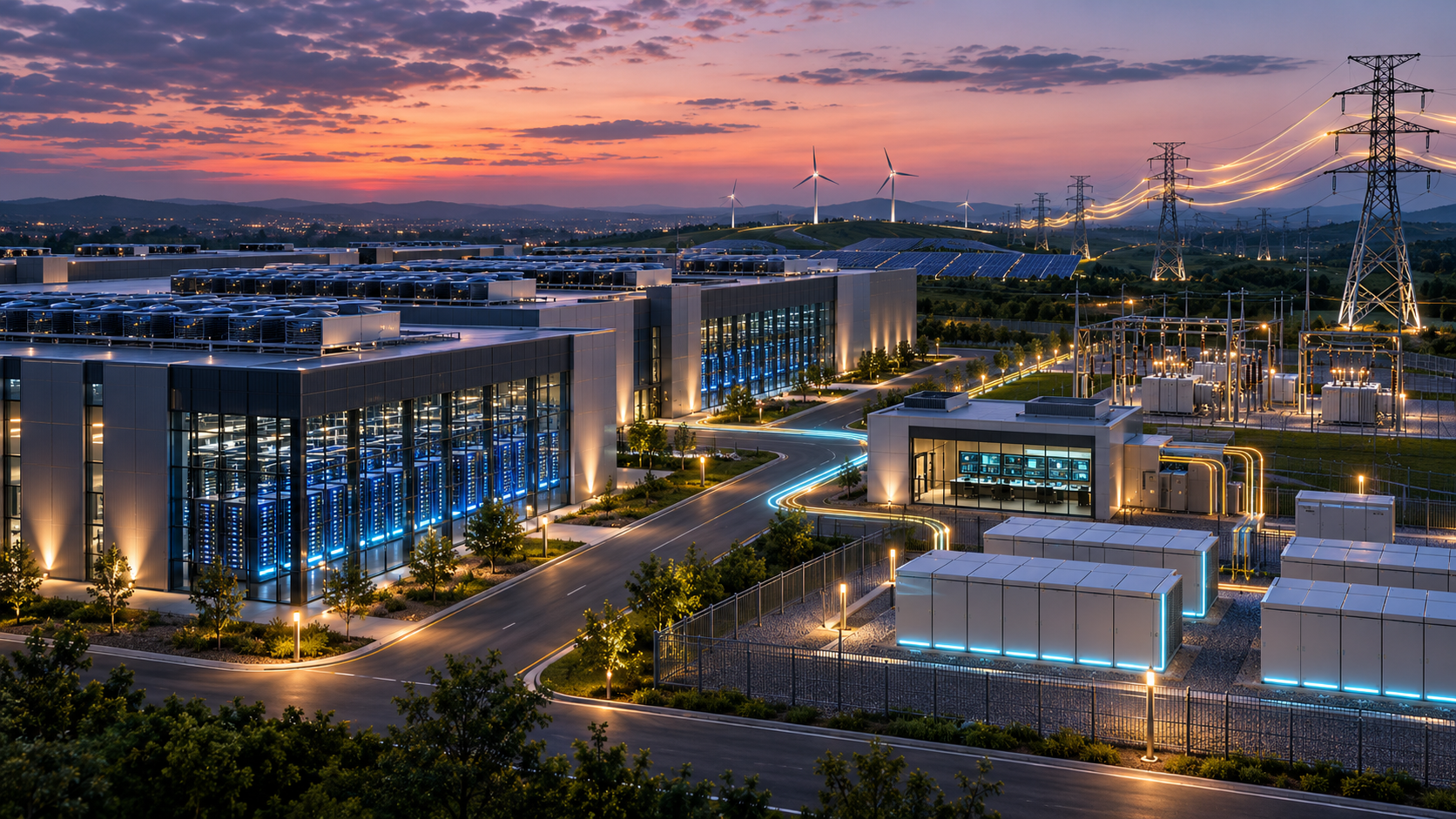
The debate over artificial intelligence infrastructure has focused on one question: how much electricity will large compute campuses consume? A more useful business question is emerging. How should these facilities behave when the grid is under pressure?
A new operating model treats the data center as a controllable energy asset rather than an inflexible block of demand. The campus still needs substantial, reliable power, but parts of its workload, cooling system, battery capacity and on-site generation can be coordinated with utilities. When demand peaks, the facility can reduce its draw or temporarily supply support.
Flexibility becomes part of the site contract
Traditional large-load agreements are built around connection capacity, rates and infrastructure cost. The next generation will also define how quickly a campus can reduce demand, how long it can sustain the reduction and which conditions trigger the response.
This is a material change in project design. Flexibility can no longer be an aspirational sustainability statement. It must be measurable, dispatchable and incorporated into the commercial agreement with the utility.
One recently announced pilot includes up to 1,000 megawatts of flexible demand response. The number is important, but the operating discipline behind it matters more. Utilities need confidence that the promised reduction will be available during extreme heat, cold snaps or other periods of system stress.
Compute workloads are not equally rigid
Some digital services require immediate response and cannot be interrupted. Other tasks can be shifted by minutes or hours, moved between regions or scheduled when generation is abundant. Training, batch processing, data preparation and certain maintenance operations may offer more flexibility than customer-facing inference.
That makes workload orchestration an energy-management function. The software layer must know which jobs can move, what service levels apply and how a power constraint affects business commitments. Energy teams and cloud operations teams can no longer work as separate specialties.
See also: research article
Batteries and controls change the economics
Battery systems are usually discussed as backup. In a flexible campus they also smooth sudden changes in demand, protect critical workloads and create time for an orderly reduction. On-site generation may provide additional support, although its value depends on fuel, emissions, local rules and operating cost.
The most important asset is often the control system. A campus needs real-time visibility into power consumption, cooling, workload priority, battery state and utility signals. Without that coordination, installed hardware cannot become dependable grid capacity.
Who pays for infrastructure is the central issue
Large computing facilities require substations, transmission upgrades and new generation. If those investments are recovered broadly from households and small businesses, local opposition will grow. Developers therefore need to demonstrate that a project pays the costs it creates and provides financial protection if construction is delayed, reduced or cancelled.
Long-term commitments, infrastructure contributions and credit support will become part of the competitive package. The strongest projects will arrive with a complete energy proposition: contracted supply, funded network upgrades, demand flexibility and a credible exit plan.
Flexibility does not replace new supply
Demand response can reduce peaks, but it cannot eliminate the need for generation and transmission. A campus that uses electricity throughout the year still requires substantial energy production. Flexibility is most valuable when combined with new supply, storage and grid expansion.
This distinction matters for corporate communication. Claiming that a campus “supports the grid” is meaningful only when the company also accounts for its total demand and the infrastructure required to serve it. Peak reduction is one tool, not a substitute for capacity.
A new diligence checklist for AI infrastructure
Investors and communities should ask five practical questions:
- How much power will the campus require at full operation?
- Which infrastructure costs are paid by the developer?
- How much demand can be reduced, how quickly and for how long?
- Which workloads and systems make that reduction possible?
- What financial guarantees protect customers if the project changes?
These questions move the conversation from broad promises to operating evidence. They also give utilities a clearer basis for comparing projects.
The competitive advantage shifts upstream
Access to chips and models remains important, but electricity strategy is becoming a core differentiator. Companies that design flexibility into the campus from the beginning can secure stronger relationships with utilities, reduce local risk and improve the economics of grid investment.
The broader lesson reaches beyond AI. Any large industrial load entering a constrained power system will face pressure to become more observable, flexible and accountable. AI campuses are simply forcing the issue sooner.
The next infrastructure leaders will not be the companies that consume the most power. They will be the ones that can prove, contractually and operationally, that their demand strengthens the system around them.