
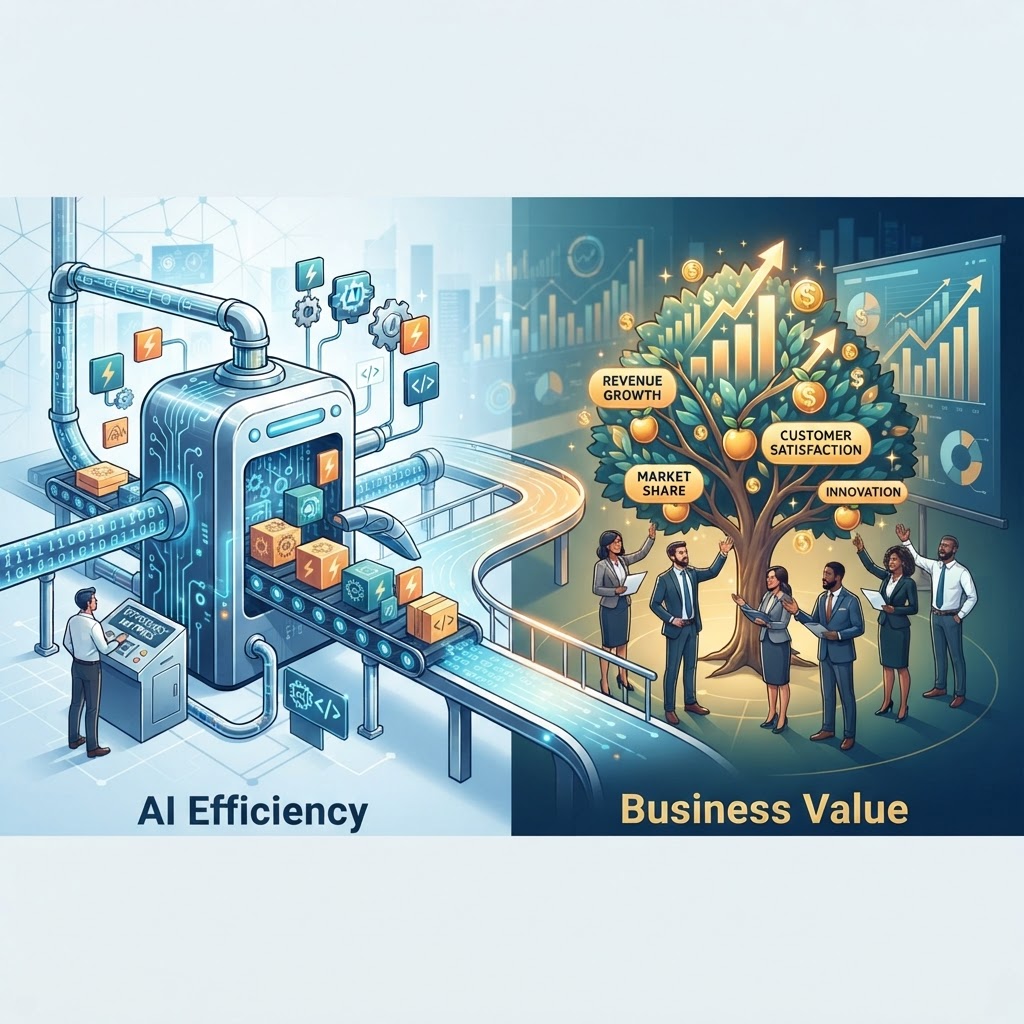
In today's corporate environment, artificial intelligence has become a crucial tool for boosting organizational efficiency. It has the power to minimize manual efforts, refine data interpretation, manage routine duties, support content production, improve client engagement, and allow departments to achieve more with decreased overhead. For leaders aiming to reduce costs, raise profit margins, and scale up operations, these benefits are extremely appealing.
The risk, however, is the inclination to mistake the velocity of task completion for the substantive worth of the business.
A company might boost its productivity, address more consumer inquiries, create additional records, and implement software to save substantial time, yet still fail to advance its market position, build trust, or improve its reputation. Although AI can quicken a company's pace, moving rapidly does not guarantee that the business is moving toward the right goals.
This worry is growing as an increasing number of firms implement AI tech. The international head of Accenture Song recently observed that in the scramble to adopt AI, enterprises might neglect the impact on brand character, the caliber of creative output, and the overall journey of the customer. Accenture Song advocates for a "creative implementation" strategy that combines inventive problem-solving with specific business objectives across every point of contact, rather than treating AI merely as a way to cut expenses. (The Australian news source)
Operational velocity is a metric, not a sustainable plan
Efficiency metrics are simple to track because they are easily quantified. A task that once took four hours can now be wrapped up in thirty minutes. A promotional strategy can be adjusted for different platforms much more often. Service agents can oversee a higher volume of messages with very little human intervention. Design teams can produce initial versions, summaries, data collections, and varied concepts at a speed that was impossible only a few years ago.
These improvements are important. They can fix operational bottlenecks, speed up projects, and free staff from monotonous work. Nevertheless, these changes do not automatically increase the value of the enterprise. If AI results in a firm creating more derivative work, offering fast but poor support, or lowering costs at the risk of user happiness, the company may grow more efficient while simultaneously losing its core significance.
The main issue isn't whether AI saves time, but how the business applies the additional time, budget, and insights it gains.
Scaling production doesn't ensure a competitive advantage
Many firms are already seeing major productivity improvements by using AI. According to the 2026 Deloitte analysis of AI in the workplace, output levels and workflow speed are the most frequently mentioned advantages, with two-thirds of companies noting these results. The study also highlights that businesses see better outcomes when top management directs the AI approach instead of leaving technical choices entirely to IT teams. (Deloitte UK)
This distinction is critical. While boosted output is often the first sign of AI working, a durable market advantage usually requires more time and a more intense internal shift. An organization can save time on its existing tasks, but if its products, services, client relations, brand voice, and company culture do not advance, the overall impact will remain limited.
McKinsey calls this the AI productivity paradox: even with rising investment and use, it is still tough to observe steady improvements in business outcomes. Their research indicates that while initial gains in speed are helpful, a bigger financial transition only happens when companies reimagine their products, revenue models, and supply chains instead of just using AI to speed up outdated systems. (McKinsey and Company)
Focusing exclusively on savings can damage brand equity
AI offers a strong case for reducing headcount in costly areas like marketing, client support, design, research, logistics, and content development. In some instances, this is practical. Not every position needs human empathy. Not every process requires complex decision-making. Not every message must be built from scratch.
However, when the main objective is just saving money, the soul of the brand can start to fade in quiet ways. Customer engagements might be faster but feel impersonal. Content might be produced more quickly but lose its unique style. Design might become cheaper but look more generic. Strategy might be backed by statistics but lack a creative spark.
This is where AI-driven speed can become a drawback. The organization gains immediate cost savings but gradually loses the factors that build preference, consumer loyalty, and the ability to command higher prices.
The worth of AI is defined by what a company decides to protect
The most effective AI strategies do more than just focus on automation. They distinguish what must stay human-driven, what should be accelerated, what needs to be more informed by data, and what must never be turned into a basic automated output.
In the field of brand loyalty and marketing, this separation is vital. AI can help with market analysis, ad variations, content customization, project tracking, and data review. It can make marketing teams more nimble. However, it cannot define a brand's core values, spot major cultural changes, decide the emotional territory a firm should occupy, or establish lasting trust.
This kind of work needs a human perspective. It calls for creative management, strategic oversight, and an understanding of the public that goes beyond simple statistics. AI can inform these actions, but if a firm swaps good judgment for automated production, it risks confusing activity with real success.
Spending is rising, but proving ROI is getting tougher
The level of AI spending makes this subject even more vital. Gartner predicts that global spending on AI will reach $2.59 trillion by 2026, a 47% jump from the previous year, while also noting that tech leaders are having trouble justifying these costs and demonstrating clear business outcomes. (Gartner Research)
This demand for results forces executives to look for quick successes. Efficiency metrics are often the simplest to show because they can be counted: time saved, automated tasks, lower overhead, and higher output. However, these data points don't necessarily prove the firm is becoming more resilient, trustworthy, unique, or profitable.
A firm might require productivity statistics, but it also needs value markers. This involves checking customer happiness, brand image, revenue growth, client retention, lead quality, service standards, creative impact, decision speed, and the strength of consumer bonds.
The 2026 debut of the Marketing Investment Navigator by Accenture Song addresses the need for improved tracking by combining marketing mix analysis, attribution, revenue trends, and brand worth into a single AI-driven system designed to help professionals link data to results throughout the consumer journey. (Accenture Newsroom)
The expenses of AI operations themselves require management
There is another reason why speed doesn't guarantee success: running AI comes with costs. As it is used across a firm, factors like token usage, model choices, processing needs, software fees, integration, monitoring, and training all affect the bottom line. A business might automate its processes while ignoring the expenses needed to keep that automation running.
The 2026 release of Accenture Tokenomics focuses on this, treating AI usage as a metric that executives must link to tangible value so that increased AI usage becomes a strategic asset rather than an unchecked expense. (Accenture Newsroom)
This underlines the central point. AI value isn't generated just because teams use more tools. It is created when AI use is intentional, trackable, and tied to major business goals.
Creative oversight is growing more vital, not less
A common mistake about AI is the idea that it reduces the need for creativity. Actually, it likely makes it more important because it drops the cost of creating average work. When any business can produce copy, images, and plans fast, the competitive edge shifts from volume to creative selection.
The question then is: what is actually worth making? What should the brand represent? What should be left out? What experience should the client remember? What idea can only this specific business offer?
AI can present choices, but strategy sets the path. AI can increase output, but creativity provides purpose. AI can personalize the journey, but brand value depends on whether that interaction feels cohesive, suitable, and sincere.
As a result, companies shouldn't view creativity as an expense to be trimmed by AI. They should see it as the main way to turn technical skills into true customer devotion.
Insights from The Design Agency
The Design Agency views AI as one part of a total business, branding, and digital plan, rather than a replacement for expert thinking. For organizations, the aim is not just to use AI more effectively, but to figure out where AI can sharpen communication, boost user experiences, raise content standards, and create genuine value without losing the brand's unique identity.
By providing consulting, brand strategy, creative oversight, content planning, social media management, and results-focused thinking, The Design Agency helps businesses link AI-enabled operations with clear targets, unified messaging, and a superior customer experience. This involves choosing where automation helps, where human expertise is still required, and how digital platforms and creative efforts can reach business targets instead of just increasing production volume.
The advantage of a strategic collaborator is helping firms ask better questions before adopting new tech. What should be faster? What should be more intelligent? What needs to remain human? What must the brand safeguard as AI changes how work is made, shared, and evaluated?
Business worth needs more than just velocity
Operational speed through AI has its benefits, but it is not the same as corporate value. Efficiency changes how chores are handled. Commercial value depends on whether those chores strengthen the company's place in the market.
The firms that benefit most from AI will not be those that automate the most chores or make the most content. They will be the ones that connect AI to better choices, improved customer journeys, stronger brands, smoother operations, and specific strategic targets.
AI can help a firm move more rapidly. But only strategy can confirm if that movement is actual progress.
Machine intelligence is altering how companies function, communicate, and create value. If you want your digital strategy to stay effective in a changing market, complete the contact form to speak with The Design Agency.

