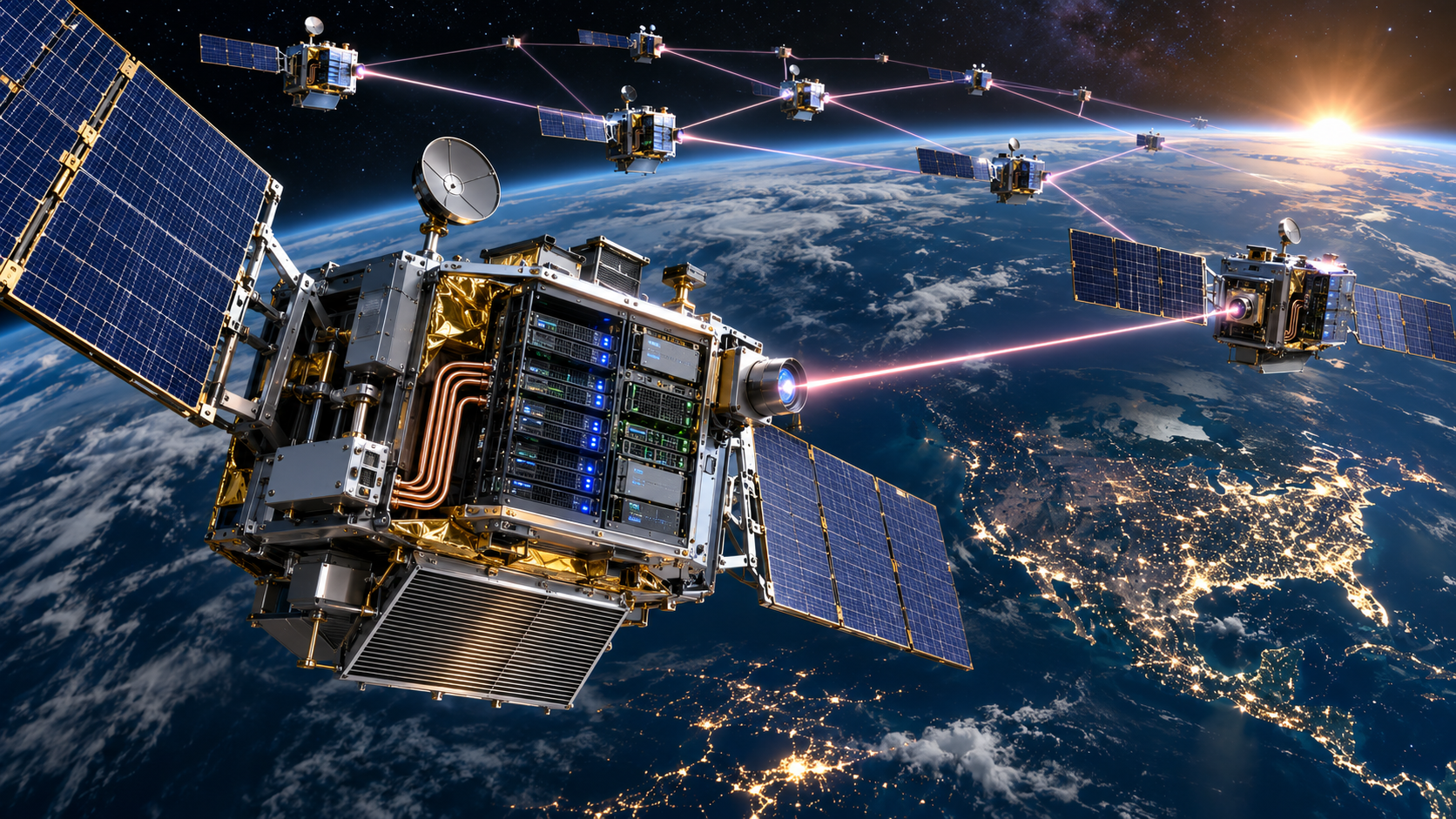
Space-based computing has moved one step closer to becoming a real infrastructure category. A newly announced heavy-lift launch plan targets the first quarter of 2029 and is designed to place a group of solar-powered computing satellites into sun-synchronous orbit. Each satellite is expected to offer computing capacity roughly comparable with a data-center rack.
That does not mean orbital data centers are ready to replace terrestrial campuses. It means the idea has crossed an important boundary: from a research concept into a project with a launch vehicle, a timetable and an initial deployment architecture. For business leaders, the most useful question is no longer whether the concept sounds futuristic. It is what conditions would have to be met for it to become economically credible.
Energy is the strategic premise
Artificial-intelligence workloads require large and growing amounts of electricity. On Earth, new capacity can be constrained by grid connections, permitting, water availability, land, transmission and community acceptance. Orbit offers abundant solar exposure and eliminates several terrestrial site constraints, at least in theory.
But access to solar energy is only the beginning. A useful system must also convert that energy efficiently, manage thermal loads, move data reliably, survive radiation and operate with limited opportunities for repair. The value proposition therefore depends on a full system, not on cheap sunlight alone.
Launch economics becomes part of cloud economics
Terrestrial data-center planning is dominated by construction, chips, power contracts, cooling, networking and financing. Orbital infrastructure adds launch cost, payload integration, insurance, debris mitigation, redundancy and eventual decommissioning. A heavy-lift vehicle can improve the equation by placing more capacity in orbit per mission, but the launch remains a material component of total cost.
The 2029 target is strategically important because it gives hardware, software and launch partners time to reduce technical uncertainty. It also creates a capital-planning horizon. Suppliers can evaluate whether specialized processors, optical links, thermal systems and satellite platforms justify dedicated investment before the first scaled deployment.
The first business cases will be selective
Orbital computing is unlikely to win by copying every workload now handled on Earth. Early use cases will need to benefit from the location itself. Processing Earth-observation data before transmitting it, coordinating satellites, running scientific models near data sources or supporting latency-tolerant training tasks may be more plausible than serving everyday consumer applications.
The most valuable early customers may also be partners rather than end users. Launch providers, chip designers, satellite manufacturers, energy-system specialists and network operators all have reasons to test how their products perform in a new computing environment. The commercial ecosystem could develop long before a general-purpose space cloud appears.
Reliability is the real brand promise
A terrestrial data center can replace failed components, add cooling or reroute power. In orbit, maintenance is difficult and expensive. That shifts the design philosophy toward redundancy, graceful degradation and autonomous operations. It also raises the standard for software observability: operators must understand system health across hardware they cannot physically access.
Cybersecurity and physical resilience converge in this model. Communications links, ground stations, control software and spacecraft systems form one attack surface. A credible provider will need to demonstrate not only compute performance but also command integrity, data protection, collision avoidance and responsible end-of-life operations.
What executives should watch before 2029
There are five useful indicators. First, whether launch schedules remain stable. Second, whether the project discloses measurable power and thermal performance. Third, whether inter-satellite and ground links can support the claimed workloads. Fourth, whether regulation and debris-management standards become clearer. Fifth, whether customers commit to specific use cases rather than general enthusiasm.
None of these milestones guarantees a profitable market. Launches can slip, costs can rise and terrestrial computing may become more energy-efficient faster than expected. The strategic signal is narrower but still significant: orbital AI infrastructure now has a timetable concrete enough to enter scenario planning.
For boards and investors, the right response is neither immediate commitment nor dismissal. It is to track the cost curve, identify business cases that genuinely benefit from orbit and understand which supplier relationships could create optionality. When an emerging technology gains a launch window, it also gains a budget conversation.